.
In the United States, until 1970, to be able to vote in elections for State Governors and the President, people had to prove that they had the equivalent of at least a primary education in order to vote. If they could not prove it, they had to pass a literacy test…
.
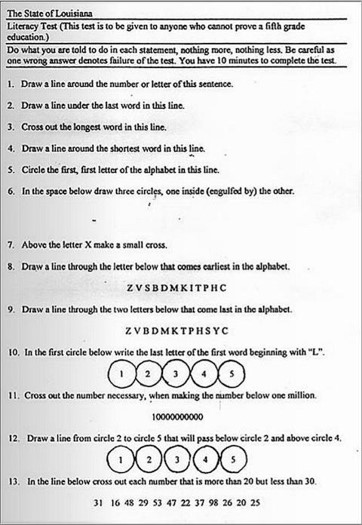
Before we start, have a go at one of these tests – the Louisiana Literacy Test (a bigger version of the text can be found under this PowerPoint on the blog). You could either time yourself or ask an adult or sibling to time you taking the test. You have exactly 10 minutes!
.
If you were not able to answer every single one of the questions, you would not pass…
.
…and so you would not be able to vote…
.
The Louisiana Literacy Test had no standard answers. The individual voting registrars determined what the “correct” answers were.
.
Task 1:
.
1) Do you think the test is a fair test? Give reasons for your answer.
.
2) Give an example of one question that is particularly confusing and explain why.
‘
3) Explain how you think people may have felt when they took the test.
.
The literacy test was mostly taken by black African Americans.
.
In America at that time, African Americans suffered discrimination in every aspect of life. They did the worst paid jobs and lived in the poorest conditions. In some states, black people couldn’t use the same public facilities as white people, live in many of the same towns or go to the same schools. Even marriage between black and white people was illegal.
.
Because African Americans were less likely to have been educated, they very often had to take tests such as the Louisiana test to be able to vote. The tests were so hard that this meant that they were unable even to vote…
.
African Americans began to protest about the racism and discrimination they faced. You may have heard the story of Rosa Parks, who refused to give up her seat on the bus to a white person. Watch the video to hear her story. (It is a dramatisation with actors)
.
.
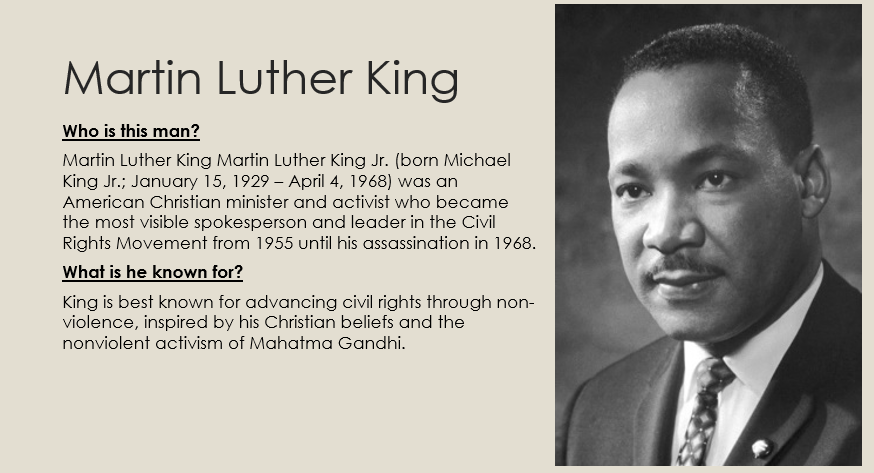
The protests and bus boycott in Montgomery were led by a pastor from a church in the town: Martin Luther King.
.